Corvynimarix
FREE KIT
FREE KIT
Couldn't load pickup availability
- 📄 Digital file available after purchase
- ♾️ Long-term availability
- 🔐 Secure checkout
- 🗓️ Content updated in 2026
Self-paced learning overview
1. Problem Statement
Starting to study PHP often involves difficulties in understanding how individual language elements interact. Syntax, variables, data types, and operators can appear to be disconnected concepts when studied without a consistent structure. Conditional statements and loops introduce another layer of logic that requires separate explanation. Functions, arrays, and input handling also require an understanding of the relationships between different parts of the code. Without organized learning materials, beginners may find it difficult to see the broader structure of a PHP script.
2. Solution
Free Kit brings introductory PHP topics together in a structured learning program. The material begins with the purpose of the language and gradually moves into syntax and fundamental programming structures. Individual modules explain variables, data types, operators, conditional statements, and loops through clear code examples. Further topics introduce functions, arrays, and introductory principles of input handling. Practical exercises help reinforce the concepts covered and demonstrate how they work together within a single PHP script.
3. What's Inside
-
Module 1: Introduction to PHP
An introduction to the purpose of PHP, the role of server-side programming, script structure, and the relationship between a request and a web application's response. -
Module 2: PHP Syntax and Script Structure
Study of syntax rules, PHP code placement, statements, comments, instruction termination, and the organization of simple scripts. -
Module 3: Variables and Data Types
Working with variables, declaration rules, strings, integers, decimal numbers, Boolean values, and type conversion. -
Module 4: Operators and Expressions
Introduction to arithmetic, comparison, logical, and assignment operators. Building expressions and understanding the order in which operations are evaluated. -
Module 5: Conditional Statements
Using if, else, and elseif to create conditional logic. Examining multiple conditions, nested structures, and alternative execution paths. -
Module 6: Loops and Repeated Operations
Study of for, while, do-while, and foreach loops. Managing repetition, using counters, and working with loop termination conditions. -
Module 7: Functions and Variable Scope
Creating custom functions, passing arguments, returning values, using default parameters, and understanding local and global variable scope. -
Module 8: Arrays and Basic Data Organization
Creating indexed and associative arrays, retrieving values, adding elements, iterating through collections, and exploring introductory approaches to organizing related data. -
Module 9: Input Handling and Basic Validation
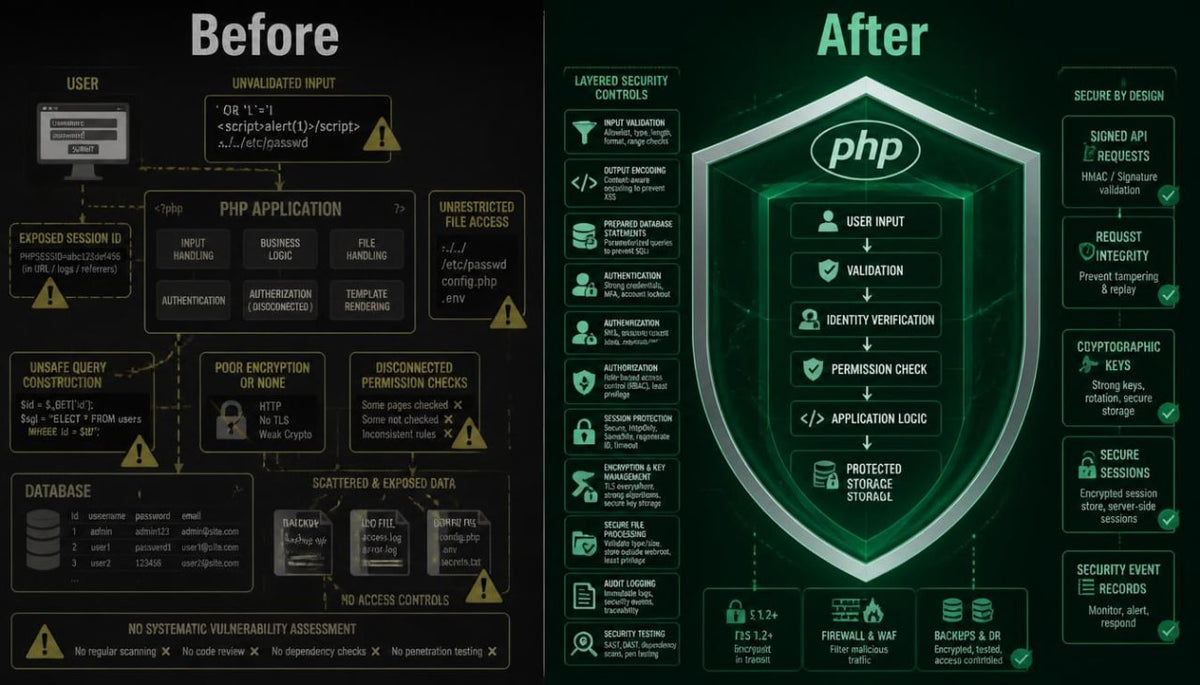
Introduction to receiving input values, working with GET and POST, checking data types and formats, and understanding the fundamentals of safe text output. -
Module 10: Reading Errors and Reviewing Code
Introduction to common syntax errors, error messages, execution sequence checks, and basic methods for reviewing and analyzing code.
4. Who Is This For?
A suitable choice if you:
- Want to explore PHP and its fundamental structures.
- Have not previously worked with server-side programming.
- Want to understand variables, data types, and operators.
- Would like to learn how to create simple functions and work with arrays.
- Prefer structured explanations supported by code examples.
- Are looking for introductory exercises for independent study.
May not be suitable if you:
- Already work regularly with complex PHP applications.
- Are looking for an in-depth study of server architecture.
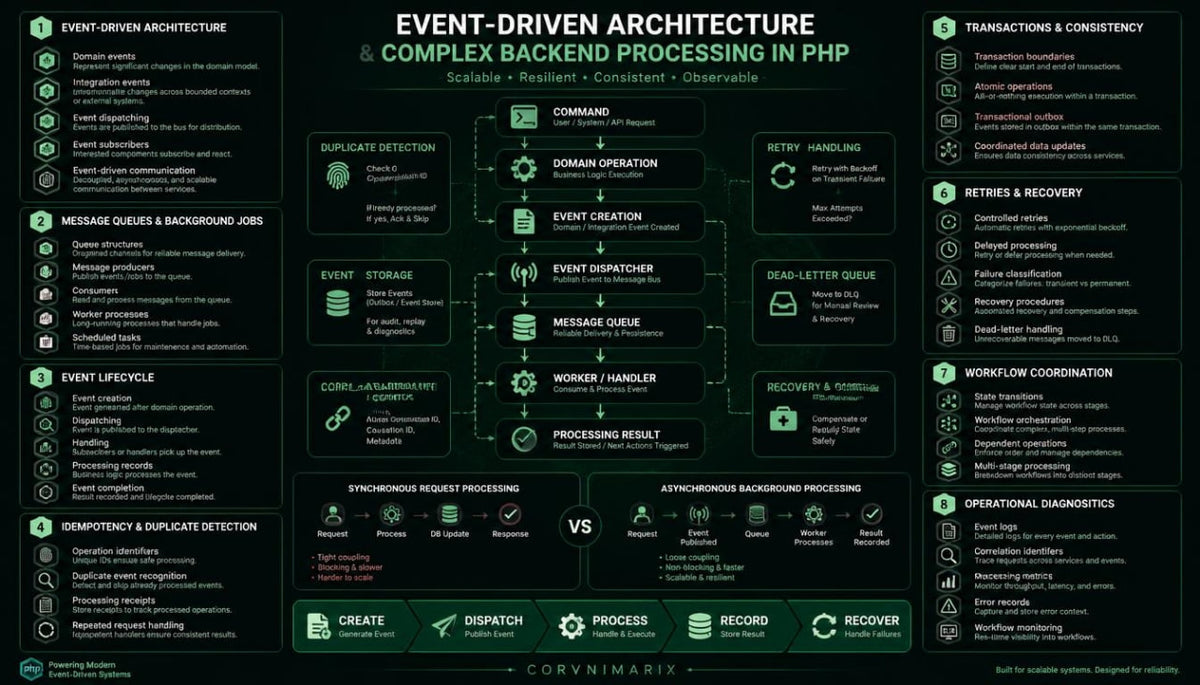
- Expect detailed coverage of asynchronous processing, scaling, and complex integrations.
- Need specialized materials on distributed systems or high-load architecture.
5. What You'll Learn
By studying Free Kit, you will explore the following areas:
- The role of PHP within web application structures.
- Fundamental syntax rules and script organization.
- Variable declarations and data type handling.
- Using arithmetic, logical, and comparison operators.
- Building conditional statements and loops.
- Creating functions with parameters and return values.
- Working with indexed and associative arrays.
- Receiving and performing introductory validation of input data.
- Reading error messages and reviewing code.
- Combining fundamental structures in small PHP scripts.
6. Refund Information
Refund request conditions and applicable timeframes are determined by the published Corvynimarix Refund Policy. We recommend reviewing the store's relevant terms before placing an order.
1. What is included in the PHP courses?
1. What is included in the PHP courses?
Each course contains structured learning modules, explanations of programming concepts, PHP code examples, and practical exercises. The exact list of topics and materials is provided on the corresponding course page.
2. Are the courses suitable for beginners?
2. Are the courses suitable for beginners?
The collection includes materials for different levels of preparation. Beginners can start with fundamental PHP concepts, while other courses cover more advanced subjects and approaches to organizing program code.
3. How do the course tiers differ?
3. How do the course tiers differ?
The tiers differ in the number of learning modules, depth of subject coverage, complexity of examples, and range of practical materials. Each subsequent course expands on earlier topics and introduces additional areas of PHP development.
Share