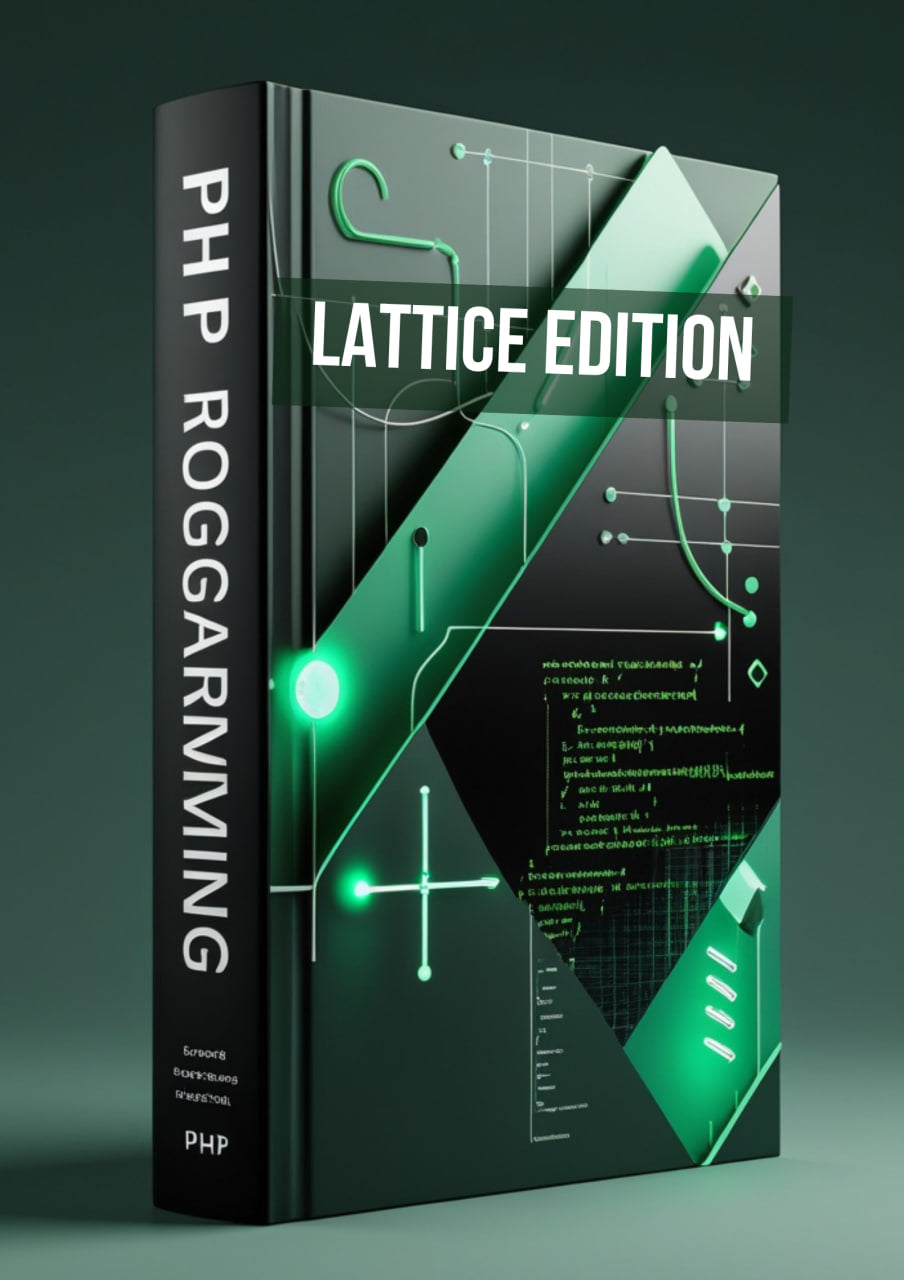
Corvynimarix
LATTICE EDITION
LATTICE EDITION
Couldn't load pickup availability
- 📄 Digital file available after purchase
- ♾️ Long-term availability
- 🔐 Secure checkout
- 🗓️ Content updated in 2026
Self-paced learning overview
1. Problem Statement
As PHP applications process increasingly large collections of information, the choice of algorithms and data structures begins to influence their overall behavior. Operations involving nested collections, repeated database queries, extensive object creation, and large datasets can consume substantial processing resources. Understanding computational complexity and memory allocation becomes important when evaluating how individual operations behave under different workloads. Database queries, caching mechanisms, and data transformation procedures also require careful analysis to identify unnecessary operations and inefficient processing patterns. Without systematic performance evaluation, application development can become focused on isolated code changes rather than understanding the underlying causes of resource consumption.
2. Solution
Lattice Edition introduces a structured approach to analyzing and improving PHP application performance. The course begins with algorithmic complexity, data structures, memory allocation, and the internal execution model of PHP. Dedicated modules explore sorting, searching, graph algorithms, collection processing, database query planning, indexing, and transaction efficiency. Further topics cover profiling, benchmarking, caching strategies, streaming, resource management, and workload analysis. The final applied project combines these concepts in a data-intensive PHP application with measurable performance indicators, documented optimization decisions, and comparative testing scenarios.
3. What's Inside
-
Module 1: Algorithmic Thinking and Computational Complexity
Explore algorithm design, time and space complexity, and performance analysis. -
Module 2: PHP Data Structures and Memory Representation
Study PHP arrays, objects, references, and memory organization. -
Module 3: Advanced Array Processing
Work with filtering, mapping, grouping, sorting, and collection operations. -
Module 4: Linked Structures, Stacks, and Queues
Explore linked lists, stacks, queues, and ordered data processing. -
Module 5: Trees and Hierarchical Data Structures
Study tree structures, hierarchical relationships, and traversal methods. -
Module 6: Graph Structures and Traversal Algorithms
Explore graph representations, BFS, DFS, and connected data structures. -
Module 7: Searching Algorithms and Data Retrieval
Compare linear search, binary search, indexing, and lookup methods. -
Module 8: Sorting Algorithms and Ordering Strategies
Study sorting methods, comparison operations, and algorithm efficiency. -
Module 9: Hash Tables and Lookup Optimization
Explore hashing, collisions, associative arrays, and key-based retrieval. -
Module 10: Recursion and Iterative Algorithms
Study recursion, iteration, termination conditions, and call stacks. -
Module 11: Dynamic Programming and Memoization
Explore memoization, tabulation, repeated subproblems, and algorithm optimization. -
Module 12: Iterators, Generators, and Lazy Evaluation
Work with PHP iterators, generators, lazy processing, and memory usage. -
Module 13: Memory Management and Object Lifecycle
Study object references, cloning, garbage collection, and memory behavior. -
Module 14: PHP Execution Model and Runtime Analysis
Explore PHP execution, opcodes, runtime configuration, and processing overhead. -
Module 15: Profiling and Performance Measurement
Measure execution time, memory consumption, and application resource usage. -
Module 16: Benchmarking and Comparative Analysis
Compare implementations through repeated measurements and controlled benchmarks. -
Module 17: Database Query Planning and Execution Analysis
Study query plans, indexes, joins, filtering, and SQL execution behavior. -
Module 18: Index Architecture and Database Optimization
Explore database indexes, selectivity, query conditions, and retrieval efficiency. -
Module 19: Database Connection Management and Query Efficiency
Study database connections, prepared statements, batching, and query optimization. -
Module 20: Transaction Performance and Lock Contention
Explore transaction duration, locking, deadlocks, and concurrent database operations. -
Module 21: Caching Architecture and Invalidation Strategies
Study caching patterns, expiration rules, invalidation, and data freshness. -
Module 22: Streaming and Large Dataset Processing
Work with generators, pagination, chunked processing, and streaming data. -
Module 23: Resource Management and Application Efficiency
Explore resource allocation, cleanup, connection lifecycles, and processing efficiency. -
Module 24: Concurrency and Parallel Workload Analysis
Study concurrent tasks, parallel processing, coordination, and resource contention. -
Module 25: Performance Testing and Load Analysis
Explore load testing, throughput, response times, and performance regression. -
Module 26: Applied Performance Studio — Large-Scale Data Processing Engine
Build a PHP data processing application with optimized algorithms, caching, and performance testing.
4. Who Is This For?
A suitable choice if you:
- Have experience working with PHP and complex data structures.
- Want to expand your knowledge of algorithms and data structures.
- Are interested in time and space complexity analysis.
- Want to learn how to compare algorithmic approaches.
- Work with large information collections and complex queries.
- Want to study profiling and performance measurement.
- Are interested in memory management and object lifecycles.
- Want to explore caching architecture and database optimization.
- Would like to study streaming and generator-based processing.
- Are looking for comprehensive practical exercises in PHP application resource analysis.
May not be suitable if you:
- Have not yet studied fundamental PHP syntax.
- Have not worked with arrays, functions, classes, and databases.
- Are looking for introductory programming materials.
- Expect only short examples without algorithmic analysis.
- Do not plan to study application performance and internal organization.
5. What You'll Learn
By studying Lattice Edition, you will explore the following areas:
- Analysis of algorithm time and space complexity.
- Organization of complex data structures in PHP.
- Processing multidimensional arrays and collections.
- Creating stacks, queues, and linked structures.
- Working with trees and hierarchical models.
- Building graphs and applying BFS and DFS algorithms.
- Using searching and sorting algorithms.
- Understanding hash tables and collisions.
- Applying recursive and iterative algorithms.
- Using dynamic programming and memoization.
- Working with iterators, generators, and lazy evaluation.
- Analyzing memory management and object lifecycles.
- Understanding the PHP execution model and bytecode caching principles.
- Conducting profiling and execution time measurements.
- Creating reproducible benchmarking scenarios.
- Analyzing SQL query execution plans.
- Designing indexes and relational data structures.
- Reducing repeated database queries.
- Analyzing transactions, locks, and conflicts.
- Building caching and invalidation strategies.
- Processing large datasets through streaming and chunking.
- Managing file and other system resources.
- Analyzing concurrent execution and task distribution.
- Conducting load and regression testing.
- Developing comprehensive PHP systems for processing large information collections.
6. Refund Information
Refund conditions for Lattice Edition are determined by the published Corvynimarix Refund Policy. Before placing an order, we recommend reviewing the refund criteria, request submission procedure, and applicable review timeframes.
1. What is included in the PHP courses?
1. What is included in the PHP courses?
Each course contains structured learning modules, explanations of programming concepts, PHP code examples, and practical exercises. The exact list of topics and materials is provided on the corresponding course page.
2. Are the courses suitable for beginners?
2. Are the courses suitable for beginners?
The collection includes materials for different levels of preparation. Beginners can start with fundamental PHP concepts, while other courses cover more advanced subjects and approaches to organizing program code.
3. How do the course tiers differ?
3. How do the course tiers differ?
The tiers differ in the number of learning modules, depth of subject coverage, complexity of examples, and range of practical materials. Each subsequent course expands on earlier topics and introduces additional areas of PHP development.
Share